
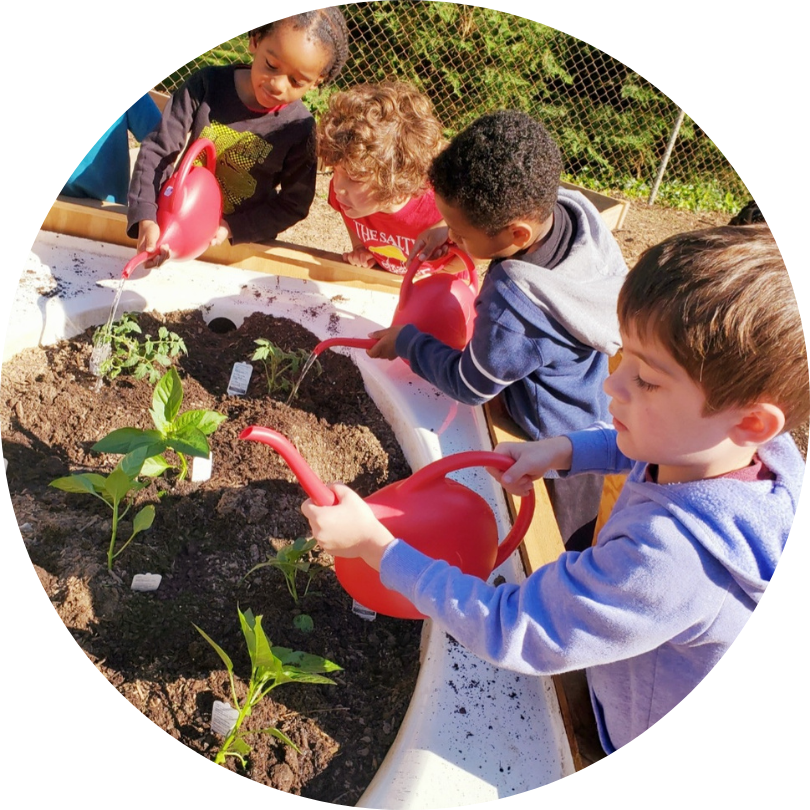
Learn an Occupational Therapist’s top ten teaching tips for gardening with children.
1. Get to know your young gardeners. Learn about their skills and needs before planning and implementing your garden activities. On gardening days, be prepared with the necessary accommodations to ensure the garden is accessible to all. While in the garden, make it a priority to acknowledge children’s efforts and strengths. Encourage friends and classmates to support each other as well.
2. Set expectations and safety rules before going to the garden. Talk with children about their job(s) in the garden, the importance of sharing and taking turns, taking good care of the plants, and what it means to be safe when working with gardening tools, especially when they are around peers.
3. Provide timelines. Timelines that facilitate a sense of predictability help children know what to expect from the activity. Before starting the activity, explain to children, “We are going to be weeding for 30 minutes today” or “Today we will spend 15 minutes gardening, and then we will move to the next activity.” You can also create signs to share with children that display the countdown to “10 minutes,” “5 minutes,” etc.
4. Create visual schedules. For activities with many steps, create pictures and visual schedules so children can see how the activity will progress. A visual schedule uses very simple pictures arranged in the same order as the written steps of the task. The intention of a visual schedule is to support children in understanding and completing the steps of an activity. A visual schedule can also help children stay focused and attentive, and ensure each step is completed in the correct order.
5. Present multisensory cues. With the goal of supporting independence, present multisensory cues as needed during gardening activities. Start by providing indirect cues first, then increasingly direct cues as needed. For example, an indirect cue would be to ask a question like “What’s the next step?” then pause to give the youth time to consider. If more support is needed, then offer a visual cue, such as pointing, to guide their attention to the task at hand. After a pause, if needed, follow up with a directable cue such as “water the plant.” Lastly, if necessary, provide a tactile/hand-over-hand cue (lightly guiding a child’s hand with your hand around theirs). This sequence helps to facilitate the best level of success possible, while honoring children where they are.
6. Get to the point! To avoid creating confusion, provide simple verbal cues with as few words as possible. Avoid filler words, including “like”, “um”, “uh”, and skip transitional phrases like “now you should,” or “next we will.” A straightforward, easy-to-follow cue is, “Scoop soil into the pot.”
7. Avoid rushing children and strive to build extra time into the day for gardening activities. Children may progress through the garden activities at different rates, so plan additional activities or garden stations that can be completed independently for those who may finish faster or lose interest more quickly, or recruit attentional support if needed.
8. Utilize timers. Visual and auditory timers can help with transitions between activities. You can set a timer on your phone, use a digital kitchen timer, or project a digital countdown on the classroom whiteboard if your gardening activity is taking place indoors. Visual countdowns and timer notifications help children prepare for the end of an activity and make it feel less unexpected.
9. Minimize distractions. Try to reduce or, if possible, eliminate distractions in the garden environment such as loud noises, harsh lighting, or strong smells. Remove any garden hazards. Provide space for breaks, such as shaded seating areas, if needed. Make sure your garden is a safe and accessible space.
10. Encourage children to be curious and make mistakes. This is how they will learn! Remember, the garden should be an engaging space for joy and learning.
Subscribe
Our FREE monthly newsletters help kids play, learn, and grow through gardening. Get the best gardening ideas for kids right in your inbox!
Related Resources
- Create an Accessible Garden for Those of all Physical Abilities
- Designing Garden Programs for All
- Everyone Grows: Introduction

Excited to garden with kids?
Explore more resources, discover funding opportunities, ask questions, and learn with other gardeners in the Kids Garden Community. Join FREE today to start connecting, sharing, and growing with educators and parents just like you!