
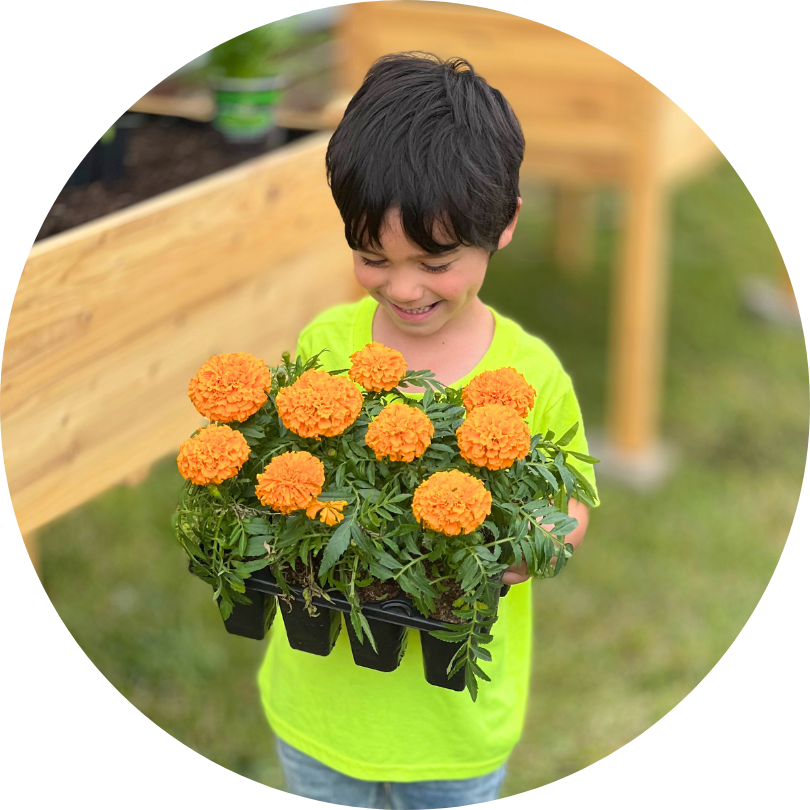
If seeds are too small to handle or too slow to grow for your young gardeners, you may want to jumpstart your garden by planting small plants called seedlings (also called transplants). You can purchase these seedlings at garden centers, or you can start your own by sowing seeds in small pots or trays. The seedlings are then transplanted (moved) into larger containers or garden beds to grow to maturity.
Planting seedlings is an activity that can address a variety of developmental skills; below is a list of these skills. In the instructions, you’ll find ideas for modifying the activity to make it accessible to learners who may have specific physical, cognitive, sensory, and social/emotional needs. This resource is designed to help ensure all children in your program can engage with and have fun in the garden.
What Skills Does This Activity Support?
Physical – Coordination, gross motor strength, fine motor skills, grip strength, bilateral coordination, range of motion, motor planning, digit opposition, pincer skills, hand-eye coordination
Cognitive – sequencing, attention, problem-solving, planning
Sensory – sensory processing, tactile, proprioception, and visual skills
Social/Emotional – perseverance
Materials
- Seedlings/transplants
- Container or garden bed
- Water
- Watering can
- Trowel
- Child-sized gloves
- Tray or table if indoors
- Scissors
- Potting mix
- Bowls
Planning Ahead
- Timing the activity: If you’ll be planting seedlings in a garden bed or outdoor container, it’s best to schedule this activity for a day when it is cool and/or cloudy because the roots of young seedlings can quickly dry out and be damaged in hot, sunny, dry weather. Newly planted seedlings need consistently moist soil, so schedule this activity for a time when light rain is in the forecast and/or someone is available to provide supplemental water for a few weeks after planting. During those weeks, the seedlings’ roots will venture into the surrounding soil, and less frequent watering will be needed.
- Decide where you’ll plant: Most plants acclimate well to growing in containers, raised beds, and in-ground beds.
- Prepare the planting area as needed: In existing garden beds, remove any plants (foliage and roots), loosen the soil, and, if desired, mix in some granular organic fertilizer. If you’re planting in a new bed, prepare the planting area. Learn more: Preparing the Soil
- Decide what to plant: Local garden centers offer an array of seedlings in spring, and/or at other times, depending on your climate. Look for easy-to-grow plants, such as tomatoes, peppers, and herbs. If you’ll be planting your seedlings in a container, choose one that’s large enough to accommodate the mature plant. Learn more: Consider Container Gardening
Activity Instructions
Day Before the Activity
If you are planting in an in-ground or raised garden bed, water the soil the day before you plan to plant so it is moist on planting day.
Day of the Activity
A few hours before you begin planting:
- Water the seedlings with a spray bottle or gentle watering can, taking care to make sure all the soil is moist but not dripping wet. If the soil in the container has dried and pulled away from the edges, set the pots in a basin of lukewarm water for an hour to allow the soil to rehydrate.
- If you are planting your seedlings in an existing container, moisten the potting soil mix in the container.
- If you’re starting with a new container and a bag of potting mix, moisten the potting mix and then fill the container to within a few inches of the top.
- Gather all your supplies: trowel for scooping or digging in soil, watering can and water, gardening gloves, potting mix (if using), scissors, tray or table (if indoors).
Begin Activity
- Determine the size of the seedling’s roots, so you know how big a hole you’ll need to dig. The easiest way to get an approximate size of the roots is to measure the pot.
- Dig the planting hole, making it slightly larger than the plant’s root ball. Most seedlings should be planted as deeply as they were growing in their containers — in other words, you don’t want to bury the stems. You can set the seedling, still in its pot, in the planting hole to confirm that the hole is the right size; adjust if needed.
- Remove the seedling from the pot. Place your hand over the soil with the seedling’s stem between your thumb and index finger. Important: Don’t pull on the stem to remove the seedling; this can damage the stem. Turn the pot upside down. If the seedling doesn’t slide out, tap the bottom of the pot to release the roots. If the roots don’t release, try squeezing the pot or rolling it on its side on a table. You can also try inserting a finger or a small tool through the drainage holes in the bottom to push out the root ball. Put a tray under the pot or go outside to complete this step to minimize spilling soil inside if that is where you are working.
- If roots are matted, gently loosen and tease them apart by pinching them with your fingers. Try to do this without ripping any of the roots. Then, holding the seedling by the soil or by the leaves, gently place it in the planting hole. The top of the root ball should be right at the soil surface. Adjust the size of the planting hole if needed. Gently backfill the soil around the root ball and pat it down so it is snug.
- Adults: If using a plantable pot, such as a peat pot, before placing the pot in the planting hole, trim any extra pot material that sticks above the soil surface. You want the rim of the pot to be even with or below the soil surface; otherwise, the exposed pot can wick moisture away from the roots.
- Gently water the seedling with a watering can so the soil is moist but not soaking wet.
- Provide plants with shelter from strong sun and wind for a week or two using floating row covers, if needed.
How to Modify this Activity for Different Learners’ Needs
Physical/Motor
- If skills like removing the seedlings gently from their pots are difficult, lay the seedling container on its side on the table. Children can then hold the container with both hands if needed and gently shake the seedling out onto the table, taking care not to damage the stem. Make sure the soil is moist; this will allow the root ball to slide out of the container more easily. Place a tray under the pot during this step to contain the soil.
- You can use other tools to loosen the roots in the root ball if fine motor skills like pinching are difficult for children. Try using a dull pencil or pen tip to gently slide and scoop under the roots to loosen them. Build up the handle of the writing tool with sticky medical tape or rubber bands if gripping is a challenge.
- The seedling can be removed from its pot without turning the pot upside down. If it’s easier, children can hold the seedling container steady with their legs while seated, or have a buddy hold the container while they lift the seedling by the foliage to remove it.
- If the root ball is too tight in the pot, try soaking it in water or gently squeezing the pot to loosen up the roots.
Cognitive
- Talk with children about the different gardening terms used in this activity. Some words like “seedling,” “transplanting,” and “root ball” may be new to some children. Explaining these before starting can help prevent confusion during the activity.
- Explain to children why it is important to tease apart the root ball. Explain that the roots are like the plant’s fingers that reach into the soil and soak up water and nutrients for the plant.
- Offer a silly example to help children understand what it means to tease the roots. Tell them you want it to look like an octopus/spider/jellyfish with lots of legs coming off it! Invite children to move their arms and legs like an octopus.
- Help children complete this activity with more independence by making a paper checklist with all the steps for the activity. Encourage them to check off tasks as they complete them.
Sensory
- Soil can be patted down after planting the seedling with a trowel or common household items like a spoon if children don’t want to directly touch the soil. They can also wear gloves.
- There is a lot to do in this activity. Help children get their wiggles out before starting by playing a game of Simon Says or freeze tag in the garden. Take breaks throughout the activity as well.
- Children can do this activity sitting, kneeling, or standing, or switch positions throughout the activity. Changing the position of the body can provide calming proprioceptive and vestibular sensory input, especially during a gardening activity where children are reaching up and down and side to side to gather materials or scoop and dig in the soil.
- Remind children to bring jackets (and possibly rain gear) for this activity if you can find a cool, cloudy rainy day to complete it.
Social/Emotional
- Encourage children to complete this activity with a buddy. This can easily be made into a two-person task, and is a great way to practice communication and problem-solving among peers.
- Check in with children throughout the activity! Some steps may take longer than others, so make sure no one is falling behind or needs help before moving on.
- Remind children that although this activity has specific instructions, it’s okay if it does not go exactly to plan. Mistakes can always be fixed!
Related Resources
- Designing Garden Programs for All
- Everyone Grows: Introduction
- Everyone Grows: An Occupational Therapist’s Top Ten Tips
Subscribe
Our FREE monthly newsletters help kids play, learn, and grow through gardening. Get the best gardening ideas for kids right in your inbox!

Excited to garden with kids?
Explore more resources, discover funding opportunities, ask questions, and learn with other gardeners in the Kids Garden Community. Join FREE today to start connecting, sharing, and growing with educators and parents just like you!