KidsGardening is excited to announce the launch of the School Orchard Lesson Guide developed in collaboration with ReTreeUS through grant funding support from a 2024 United States Department of Agriculture Patrick Leahy Farm to School Grant and a 2024 Onion Foundation Environment Program Nature Learning Grant.
Trees bearing edible fruits and nuts have been an integral part of food webs and natural ecosystems for thousands of years. Apples, pears, peaches, plums, cherries, citrus, almonds, and many others are widely available around the world. Early additions to cultivated land, orchards have been intentionally planted by people to guarantee a bountiful harvest of these delicious and nutritious treasures.
Recognizing the learning opportunities available in an orchard, ReTreeUS founder Richard Hodges launched the organization to support schools in installing and maintaining vibrant schoolyard orchards. Since 2012, ReTreeUS has helped establish 108 school and community orchards throughout the Northeast.

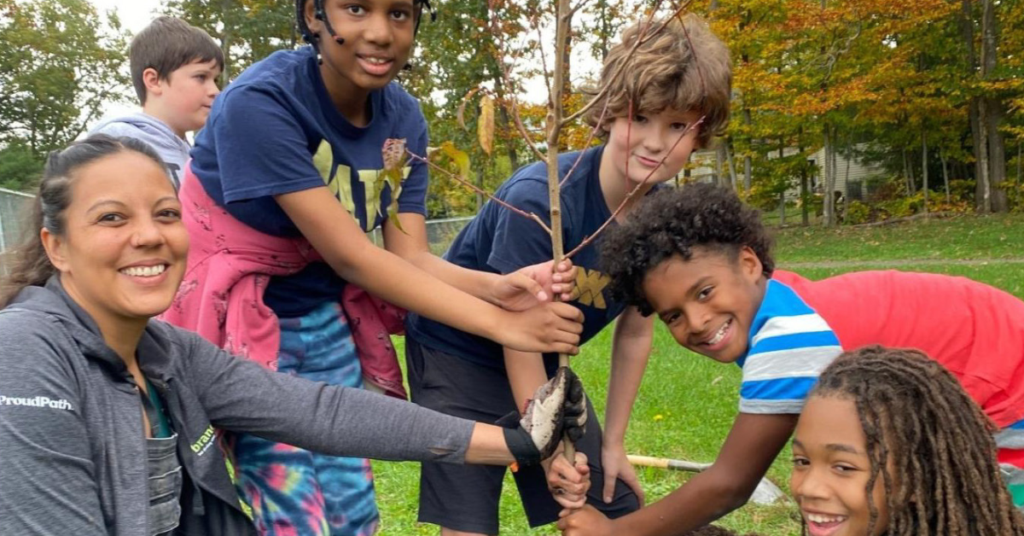
Planting a school orchard creates a dynamic, living educational tool that’s perfect for hands-on explorations, engaging observation, and experimentation. Orchards provide students with the opportunity to learn about food origins as they also discover how to contribute to local food security. Planting and caring for trees, harvesting fruit, and other orchard activities not only nurture lifelong skills, they also bolster an enthusiasm for eating nutritious and tasty fresh foods. School orchards foster environmental awareness and community connections too!
Orchard Caretaker and ESL teacher Katarina Arvedson has noticed a difference in her students after working in their school orchard. Katarina shares, “I always get to hear more language from my new Mainers when I bring them outside to our orchard. I get to see sides of them I’ve never seen before, like a sixth grade girl hauling buckets of water, muscles bulging with pride and joy. A student I struggled to connect with is now better behaved and working as hard as he possibly can. Working side by side created a connection that carries back into the classroom.”
Achieving these amazing school orchard benefits requires planning and to reach their greatest potential. This School Orchard Lesson Guide was created to help educators integrate a school orchard into their curriculum to maximize its use as an educational tool. It includes 10 modules designed to connect with K through 6th Grade Next Generation Science Standards, but it can be linked to other areas of the curriculum if desired. The modules are sequenced so that each topic builds upon the previous topics. However, they can also be used independently, in any order. Depending on how often classes visit the orchard, a different module could be taught each month of the school year or used more intensely as part of a dedicated Orchard Unit. The modules can also be spread out seasonally among different grade levels and introduced during orchard visits over multiple years. The pacing of implementation can vary greatly based on time and resources available for school orchard programming.
Each module includes learning objectives, a materials needed list, educator background information and references followed by instructions for lesson activities. To fully engage students in the topic, the lesson includes four distinct activities including a Laying the Groundwork, Exploration, Making Connections and Branching Out engagement. Each module also includes a link to a slide presentation that can be used to introduce students to the content shared in the educator background information and a video from ReTreeUS.

The Modules include:
Module 1: Introduction to Orchards: In this module, students dig into the history of orchards and explore the role they play in our global food systems.
Module 2: Benefits of Fruit and Nut Trees in Ecosystems: In this module, students explore how planting fruits and nut trees benefits the environment and their community beyond the foods they produce for human consumption.
Module 3: Soil, Decomposition and the FBI: In this module, students “dig” deep into the soil biome and learn about the important role of the FBI (fungi, bacteria, and invertebrates). They will explore the decomposition cycle and discover ways to improve orchard soils.
Module 4: Planting Fruit and Nut Trees: In this module, students learn how to plant fruit and nut trees and how to use tools safely.
Module 5: Fruit and Nut Tree Needs: In this module, students learn about the basic needs of fruit and nut trees and discover how this information can help them plan and maintain an orchard.
Module 6: Fruit and Nut Tree Biology: In this module, students explore plant parts and learn about the life cycle of fruit and nut trees.
Module 7: Pollinators: In this module, students learn pollination basics and the critical role pollinators play in orchard life.
Module 8: Making New Fruit and Nut Trees: In this module, students explore how new fruit and nut trees are grown. They will expand on what they learned about pollinators to understand that fruit and nut trees grown from seed may be similar, but not exactly like their parents. They will learn about grafting and why so many orchard trees are grown using this propagation technique.
Module 9: Fruit and Nut Tree Survival: In this module, students explore the natural adaptations and structures of fruit and nut trees that help them survive in their native environments and which carry over to orchard life too. They will also explore techniques growers use to provide an additional layer of defense for trees against common challenges.
Module 10: Orchard Maintenance and Sustainability: In this module, students learn how to care for school orchard fruit and nut trees. They will be introduced to the basics of staking, watering, fertilizing, mulching, weeding, pest management, harvesting, and pruning while also learning why each of these contributes to overall tree health.
Download the School Orchard Lesson Guide to begin your fruit growing adventure!