
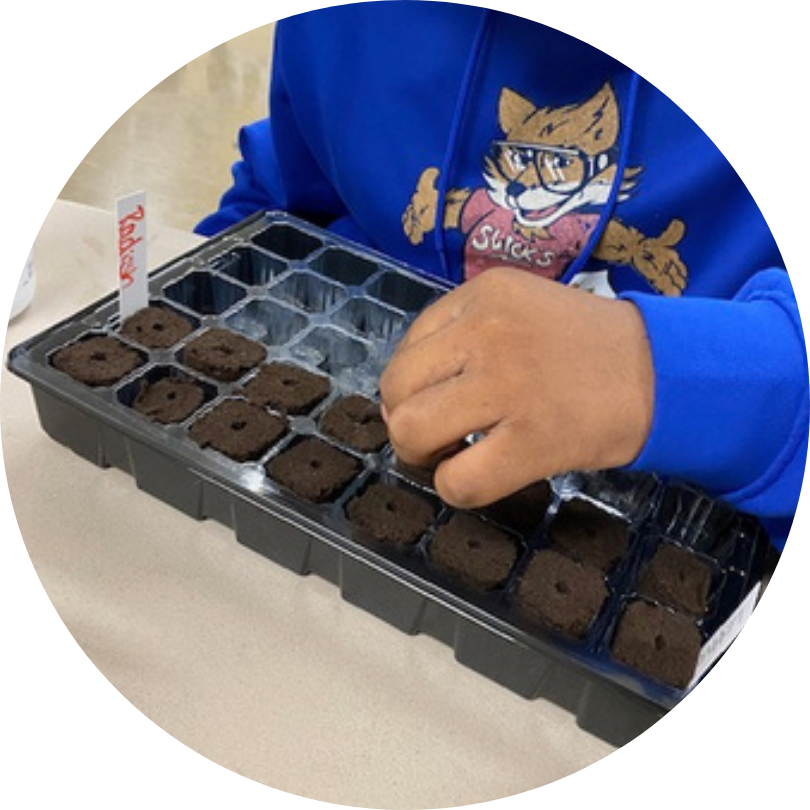
Indoor seed planting is one of the most common activities for any garden program, offering students the chance to observe the wonderful transformation of a small seed into a growing plant. Not only is it an excellent learning activity for young gardeners, but it also gives them the opportunity to master foundational skills. In this activity, children will sow seeds in small pots, observe them for signs of growth, and care for the germinating seeds and young seedlings.
Below you will find a list of developmental skills this indoor seed planting activity can address. In the instructions, you’ll find ideas for modifying the activity to make it accessible to learners who may have specific physical, cognitive, sensory, and social/emotional needs. This resource is designed to help ensure all children in your program can engage with and have fun in the garden.
What Skills Does This Activity Support?
Physical – fine motor skills, grip strength, bilateral coordination, range of motion, digit opposition, in-hand manipulation, visual perceptual skills
Cognitive – problem solving, sequencing, inhibition
Sensory – sensory processing, proprioception, tactile and visual skills
Social/Emotional – perseverance
Materials
- Planting pots: These can be purchased seed-starting pots or repurposed items, such as small plastic yogurt cups or other 2” to 3” deep plastic containers. Pint- and quart-sized milk and juice cartons with the tops cut off are other options.
- Drip trays, such as plastic container lids or sheet pans
- Soilless potting mix (ideally one made for seed-starting)
- Large bowl or bucket (for moistening planting mix)
- Waterproof table covers
- Water
- Trowel, large spoon, or other tool for scooping soil
- Small plates or shallow bowls
- Spray bottle and/or small watering can
- Seeds: Cucumbers, tomatoes, lettuce, cosmos, marigolds, and zinnias are good options
Optional materials for activity modifications: Child-sized disposable gloves, spice container with slotted lid, measuring cup
Planning Ahead
- Create drainage holes in pots, if needed. If using repurposed containers, poke several ¼” diameter holes in the bottom of each pot. Depending on the type of container, this may need to be done by an adult with a pen/pencil, screwdriver, or drill.
- Moisten the soilless potting mix. Pour it into a large bowl or bucket, add warm water, and stir. Peat-based soilless mixes tend to repel water; you may need to add some water, stir, and let the material sit, repeating until the mix is evenly moist (like a damp sponge) but not soaking wet.
Activity Instructions
- Cover tables with waterproof table covers.
- Using hands or a tool to scoop, add moist potting mix to each planting pot, filling them to within ½” to 1” from the rim of the pot. Gently tap the pots on the table to settle the mix and eliminate air pockets. You can also settle the potting mix by pressing the surface with fingers or another pot.
- Open a seed packet and place the seeds on a small plate or in a shallow bowl. Keep the seed packet with the seeds so you can refer to it.
- Read the seed packet to determine planting depth. Poke holes in the potting mix to the proper depth using a finger, a pencil, or a similar tool. Some types of seeds should be pressed onto the soil surface rather than covered with potting mix, so they won’t need holes.
- Sow one or two seeds in each planting hole and scatter potting mix over the holes to fill them.
- Place the pots on waterproof drip trays to protect surfaces. Carefully water the potting mix using the mist setting of a spray bottle, taking care not to dislodge the seeds.
- Place the pots in a warm spot. Most seeds germinate best at 70 to 80 degrees F. In dry environments, cover the pots with a plastic bag to increase humidity and keep the soil moist.
- Check pots every few days, adding water as needed to keep the potting mix consistently moist but not soggy.
- Once seedlings emerge, move the pots to a bright, slightly cooler spot. Most seedlings grow best in temperatures of 65 to 70 degrees Fahrenheit. Place pots on sunny south- or west-facing windowsill or, even better, under grow lights positioned 2 to 3 inches above the tops of the seedlings. Water from the bottom by adding water to the drip tray and allowing the potting mix to absorb the water through the drainage holes. This encourages root development and avoids getting water on leaves, which can lead to disease problems. After an hour or so, drain excess water from the drip tray to prevent over-saturating the soil, which can lead to root rot.
- When plants have two sets of leaves, begin watering with soluble fertilizer diluted to half-strength.
- Once the seedlings are about 3” tall and/or have their third set of leaves, transplant them to larger pots. Continue watering the plants so that the potting mix stays moist but not wet.
- When plants are ready for their next home, follow the instructions for the activity Planting Seedlings.
How to Modify this Activity for Different Learners’ Needs
Physical/Motor
- Adjust the tip on the spray bottle to make it easier or harder to squeeze the handle by turning the tip to the right or left. You can also use a small watering can or cup to water the plants if it’s easier.
- If children have a hard time picking up small seeds, keep them in the packet and have them shake out the seeds. You can simply poke a small hole in the seed packet or snip off the corner with scissors. You can also place the seeds in a clean spice container with a slotted lid. Control the number of seeds that can come out of the slotted lid by taping over excess holes.
- Mark the planting containers at ½ inch to 1 inch below the rim of the container with a sharpie before starting the activity so that children can see how much soil to put inside the container.
- Using tools with larger handles can make them easier to hold on to. Wrap the handles with medical webbing tape or foam handle grips to make them larger. Another great option is plastic trowels that may be lighter and easier for some children to grasp.
Cognitive
- Provide step-by-step written or verbal directions to encourage proper plant watering. Tell the children, “This plant needs 5 squeezes from the spray bottle, nothing more!” or “This plant needs to be watered from the watering can for 3 seconds, let’s count together!”
- Provide children with the simple instructions listed above or pictures of each step to follow along with while completing this activity.
- Assist children with interpreting the seed packet instructions. After reading the instructions together, help write a short, simple bullet-point list of the most important information, such as the number of seeds to plant, how far apart to plant them, and the proper depth.
- Provide one task at a time, moving on to the next as one is completed, rather than running through them all at the beginning of the activity.
Sensory
- Give children the option to wear gloves during this activity if it makes them feel more comfortable.
- Introduce children to the tactile sensations of soil through a playful introduction activity, like a soil treasure hunt. Hide small objects, like plastic toy animals, in a container of soil and invite them to dig around with their hands or a small trowel or spoon.
- Provide hand towels for children to clean their hands or have easy access to a sink or bowl of water to wash them throughout the activity.
- If the entire activity is done in one session, provide opportunities for sensory/movement breaks! Short, simple activities like 15 seconds of wall push-ups or 10 crab walks provide proprioceptive sensory input and can help children who trend towards sensory-craving behaviors to feel calm and regulated, increasing engagement with the gardening task!
Social/Emotional
- Try this activity with a partner, encouraging turn-taking among peers.
- As this activity has many steps, ensure you have extra time in your day to complete this activity. Allow children to take their time and limit rushing them through the steps.
- Build in time for breaks and check-ins throughout this activity. Between steps 2 and 3 might be a good time to allow children a break or the chance to catch up before their peers move on. We want everyone to feel present and comfortable while learning about gardening.
Explore the full resource guide: https://kidsgardening.org/resources/everyone-grows/
Related Resources
- Everyone Grows: Introduction
- Everyone Grows: An Occupational Therapist’s Top Ten Tips
- Everyone Grows: Planting Seedlings
Subscribe
Our FREE monthly newsletters help kids play, learn, and grow through gardening. Get the best gardening ideas for kids right in your inbox!

Excited to garden with kids?
Explore more resources, discover funding opportunities, ask questions, and learn with other gardeners in the Kids Garden Community. Join FREE today to start connecting, sharing, and growing with educators and parents just like you!