
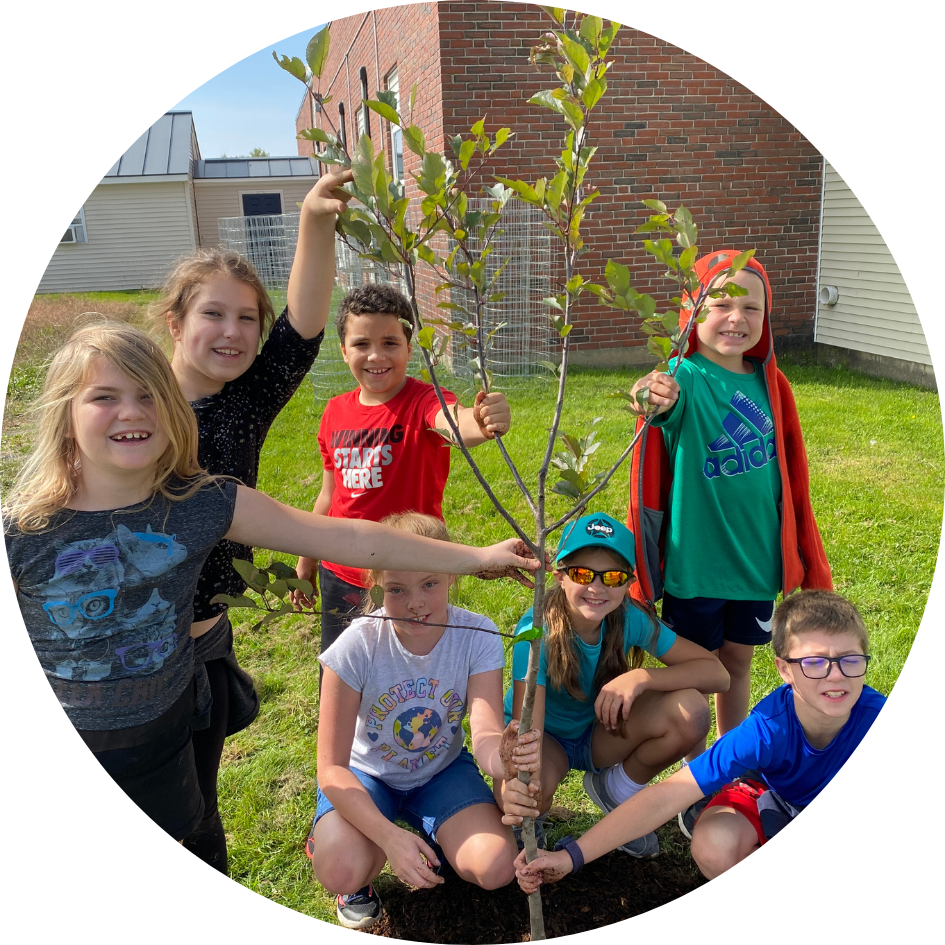
Combine the joy of growing edible fruit and the legacy of planting a tree by adding a fruit tree to your home or community garden. Short on space, no worries! Some varieties can be happy growing in large containers. This activity walks you through the process of selecting just the right fruit tree for your garden.
Materials
Instructions
Find a location where you can grow a fruit tree. Fruit trees need light, water, healthy soil, and nutrients to grow. Most will do best when they can receive at least 8 hours of full sunlight a day during the growing season and when planted in well-draining soil. If your space is limited, you can search for dwarf fruit tree varieties selected for their compact growth. Once you select a location, determine if you are going to plant in the ground or in a container(s).
2. Investigate fruit tree pollination. To make their fruit and seeds, all flowering plants must find a way to move the pollen found on the stamens of their flowers to the pistils. Pollination can be accomplished through the help of water, air, and (our favorite) pollinators! Many fruit trees especially require the help of pollinator friends, animals that visit flowers to enjoy nectar and pollen and inadvertently transfer pollen from flower to flower.
Some fruit trees are self-pollinating, which means the pollen from their flowers can be used by flowers on the same tree to trigger the production of fruit. Citrus fruits are often self-pollinating. If you only have enough room for one fruit tree in your garden, you need to select a tree variety that is self-pollinating.
Other fruit trees require cross-pollination, which means that pollen from the stamens on one tree must be moved to the pistils of flowers on another tree in order to produce fruit. Many of our common fruit trees, such as apples, peaches, plums, and pears, often require cross-pollination. If you want to grow a fruit tree that requires cross-pollination, make sure you have room to grow at least two fruit trees, or be prepared to recruit a few nearby neighbors to join you in growing fruit trees. Pollinators like bees are very important for trees that require cross-pollination, so you might want to consider planting for pollinators too.
3. Research your USDA Zone and the number of chilling hours your location receives. Weather conditions greatly impact what kind of fruit trees will grow well for you.
USDA Zone: The United States Department of Agriculture (USDA) created the Plant Hardiness Zone Map by dividing the country into zones based on average annual extreme minimum winter temperatures. The coldest zone is 1, and the warmest zone is 13. Learn more about plant hardiness zones.
Fruit trees have varying tolerance for cold weather. Some trees have special adaptations that help protect their cells from freezing temperatures, like apple trees, but other fruit trees are very sensitive to cold, and their cells will die if temperatures drop too low or stay too long below freezing, like citrus fruits. Conversely, some trees cannot survive when temperatures are too hot. This chart shows some of the preferred zones for many of our common fruit trees:
Preferred Hardiness Zones of Common Fruit Tree Crops
| Crop | Preferred USDA Hardiness Zones: |
| Apple | Zones 3-9 |
| Avocado | Zones 9 -11 |
| Cherry | Zones 4-9 |
| Coconut | Zones 10-12 |
| Fig | Zones 7-11 |
| Nectarine | Zones 4-9 |
| Lemon | Zones 9-11 |
| Lime | Zones 9-11 |
| Orange | Zones 9-11 |
| Peach | Zones 5-9 |
| Pear | Zones 4-9 |
| Plum | Zones 4-9 |
If you really want to grow a fruit tree that is not recommended for your zone, be prepared to offer some protection from weather extremes, such as planting in a container so that you can bring it inside for the winter, providing protection from extremely cold temperatures with mulch or blankets, or in warmer climates, shade during the heat of the summer.
Chill Hours: Most of our common fruit trees are deciduous. They lose their leaves in the fall in response to shorter days and cooler temperatures, entering a state of dormancy to help the trees survive winter. To make sure the leaf and flower buds that developed the previous summer/fall do not begin to grow too early, many fruit trees must accumulate a certain number of chill hours (time where the temperature is roughly between 32- and 45-degrees F) before leaf and flower buds will begin to grow in the spring. This adaptation is important for plant survival and is a critical factor to consider when choosing fruit trees for your space. For optimal success, you must select plants and varieties whose required chill hours are similar to the average chill hours in your area. If you plant trees requiring more chill hours, although you will probably still have acceptable leaf growth for the tree to survive, you will most likely experience low fruit production. If you plant trees that require fewer chill hours, they may start to grow too early and be killed by freezing weather. Find your chill hours using the Map of Chilling Hour Accumulation from the Midwestern Regional Climate Center of the USDA and NOAA.
Chilling Requirement Ranges for Common Fruit Crops
| Crop | Average Chilling Hours Required |
| Apple | 800-1,000 |
| Cherry | 700-1000+ |
| Fig | 100-200 |
| Nectarine | 400-900+ |
| Peach | 300-800 |
| Pear | 400-900 |
| Plum | 400-700 |
Subscribe
Our FREE monthly newsletters help kids play, learn, and grow through gardening. Get the best gardening ideas for kids right in your inbox!
4. Using the information collected about your space and environmental conditions, research fruit trees that would grow well for you. Two great resources to help you on your search include your local Extension Office and/or local plant nurseries.
As you search, you will find that recommendations are not just listed as apple tree or peach tree, but rather they will also include variety names like ‘Golden Delicious’ apple or ‘Saturn’ peach tree. What do those names mean?
Plants are grouped by similar characteristics, and each species is given an individual classification (a Latin genus and species name) to distinguish it from other plants. However, a new seedling or vegetative shoot may exhibit characteristics that 1) are different enough from the species to warrant a special classification but not so different as to be considered a separate species, and 2) make it worthy of cultivation in its own right. We call these plants varieties if they occur in nature or cultivars (short for “cultivated varieties”) if scientists develop them in plant-breeding programs.
Using apples as an example, the scientific classification (genus and species) for most edible apples is Malus domestica. However, it is estimated that there are over 7,500 varieties/cultivars of apples grown around the world. Varieties and cultivars may differ from each other in several ways, including but not limited to:
Physical characteristics (e.g., ‘Red Delicious’ apples produce red fruit and ‘Golden Delicious’ apples produce yellow fruit)
Tolerance for different growing conditions (e.g., ‘Dorsett Golden’ apples only need 100 chill hours to produce fruit, but ‘Granny Smith’ apples need 600 chill hours)
Harvest time (‘Ginger Gold’ apples ripen five weeks earlier than most other varieties, while ‘Gold Rush’ is a late-ripening apple)
Note that botanists put the variety or cultivar name in single quotes after the genus and species — for example, Malus domestica ‘Ginger Gold’ — but in common usage, this would simply be called a Ginger Gold apple.
On a scientific level, the different classifications among varieties and cultivars can be very complex, but on a practical level, grouping fruit trees such as apples by certain characteristics makes it easier for gardeners and farmers to find the plants that will perform best in their orchards. When researching plant varieties, you can find information on tree size at maturity, recommended USDA zone, and required chill hours, which will help you decide what is a good fit for your garden.
5. Choose your fruit tree. Use all the information you gathered to choose one or more fruit trees that will thrive in your garden’s conditions and sound fun to grow! If you want to grow in containers, there are many citrus varieties that might work, including lemons, limes, and mandarins, or choose a dwarf variety that will stay compact. If your research has discouraged your pursuit of planting a fruit tree, you may want to consider a fruiting shrub like a blueberry or raspberry instead.
For more information about planting fruit trees, check out the Fruit Tree Growing Guide and Module 4 of the School Orchard Lesson Guide.
Related Resources

Excited to garden with kids?
Explore more resources, discover funding opportunities, ask questions, and learn with other gardeners in the Kids Garden Community. Join FREE today to start connecting, sharing, and growing with educators and parents just like you!