We’re excited to welcome Carrie Strohl, the founder and leader at The School Garden Doctor to the KidsGardening blog today! We (virtually) met Carrie at the National Children and Youth Garden Conference this summer, and asked if she’d share a bit about her work with our audience.
As students, teachers, and parents prepare for another season of distance learning, food education may be just the antidote to social isolation and disengagement. Seed catalogs, nurseries, and professional organizations are reporting an increased interest in gardening at home. Economic realities and restrictions for restaurants also may have pushed more people to cook at home.
Educators can take advantage of this opportunity to build community through cuisine. Teachers do not need to be accomplished cooks or expert gardeners to engage in food education. They simply need to be interested in using food as a way to explore students’ backgrounds and connect learning in real and meaningful ways.
Many organizations are bridging the gap between virtual and experiential education during school closures, so there are already many lessons to choose from! For example,The Edible Schoolyard in Berkeley, CA, released a large repository of tried and true cooking and gardening activities. These resources were developed last spring to keep kids cooking and gardening at home. Likewise, the Food Literacy Center in Sacramento, CA, worked with multiple community partners to distribute veggie cooking kits to students challenged by food insecurity.
The School Garden Doctor (based in Northern California) is promoting the program Common Core Cooking designed to empower teachers to find time in the school day to teach food literacy all year long. It uses a classroom-tested model — known as “Eat-Read-Talk-Write” — which aligns instruction to the Common Core State Standards (CCSS) for English Language Arts/Literacy and Next Generation Science Standards (NGSS).
Here’s a sample activity that can be done at home before a literacy lesson focused on reading comprehension and narrative writing.
Theme: Trying New Things
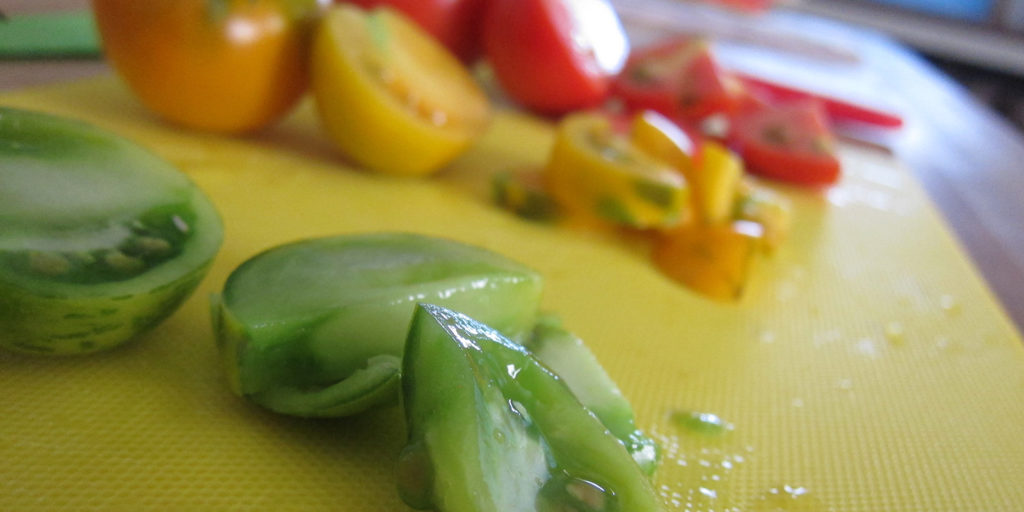
Lesson: Triple Tomato Tasting
Text: I Will Never, Not Ever, Eat a Tomato!
- Gather three different types of tomatoes. Select varieties of different colors, shapes, and sizes.
- Thoroughly wash and sanitize hands, tools, tomatoes, and preparation surfaces.
- Cut each tomato in half. Place one half of each tomato on a separate plate. Then cut the other half into bite-sized pieces.
- Create interest by involving children in the preparation process or by asking probing questions, such as: “Do you think these tomatoes will taste the same?”
- Invite students to taste a piece of each tomato, one at a time. Never force or pressure students to taste. Let them choose, and reassure them that it’s okay if they don’t like it. (Remind them that no “Mr. Yuck” faces are allowed!)
- After each variety, ask, “How did it taste?” Younger students may need you to provide vocabulary like “sweet” or “tangy.” Alternatively, ask for a “thumbs up” or “thumbs down” rating.
- After trying each variety, take a vote. Ask each taster to select their favorite-tasting tomato. Make a simple representation of tasters’ “likes.” Invite them to take another taste of their favorite tomato.
- Read the book, I Will Never, Not Ever, Eat a Tomato, by Lauren Child. Discuss how amazing it is that Lola and Charlie eat their veggies!
Even in a global pandemic, people need to eat, so putting food at the center of instruction can connect home and school in meaningful ways during distance learning!
Want to know more? Check out Carrie’s YouTube playlist and be sure to follow her on Instagram!
About the Author
As the founder and leader of The School Garden Doctor, Carrie Strohl believes that all students deserve access to cooking and gardening in school. If you would like more ideas for tasting lessons or cooking activities for fall semester, visit https://www.schoolgardendoctor.org/common-core-cooking.