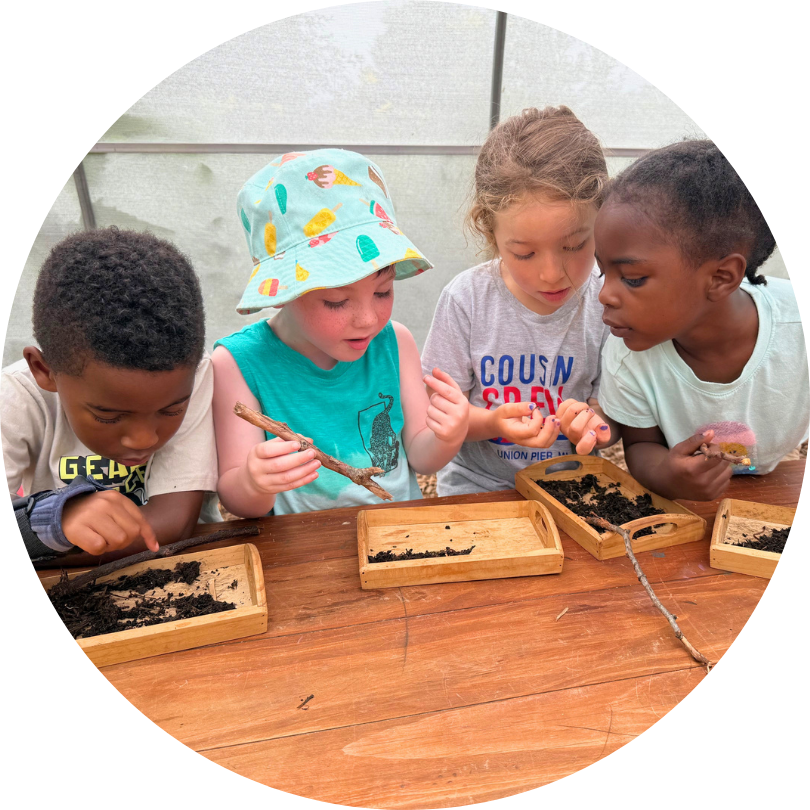
Collecting data in the garden is a great way to practice basic math and science concepts in a practical way, while also learning more about living systems and nature. Data collection demonstrates to children how the scientific method can be used to answer questions and reach conclusions. In this activity, young gardeners are encouraged to be curious and then follow the steps of data collection to discover answers to their questions — just like a true scientist!
Below is a list of developmental skills that data collection can address. In the instructions, you’ll find ideas for modifying the activity to make it accessible to learners who may have specific physical, cognitive, sensory, and social/emotional needs. This resource is designed to help ensure all children in your program can engage with and have fun in the garden.
What Skills Does This Activity Support?
Physical – Fine motor skills, coordination, hand eye coordination, visual skills, motor planning
Cognitive – attention, compare and contrast, memory, planning, problem solving, sequencing, executive functioning
Sensory – sensory processing
Social/Emotional – communication, emotional regulation, patience, perseverance, resilience, teamwork, cooperation
Materials
- Pen or pencil
- Notebook
- Clipboard
- Recording device or smartphone
- Calculator, ruler, scale, and/or other measuring devices as needed
- Garden supplies needed for experiments, such as gloves, pots, soil, watering can, seeds, shovels, trowels, and rakes
Planning Ahead
- Decide how you’ll convey the steps to a meaningful scientific exploration. Scientists follow a series of steps, sometimes called the scientific method, to investigate questions, test ideas, and increase their knowledge of the world around them. Steps include asking a question, conducting background research, formulating a hypothesis, designing and conducting an experiment, analyzing the experimental data, drawing conclusions, and communicating the results.
- Decide how you’ll convey the activity instructions. This will depend on the children’s ages and abilities. You can print them out and distribute them as a step-by-step reference guide for children to read and follow. Otherwise, you can read each prompt to children at the appropriate time.
Activity Instructions for Data Collectors
- Decide what you want to collect data on. Choose a gardening topic that interests you or something that you have always wanted to learn more about.
- Think of and then write or record a question about your topic of interest. This question can be simple, like “Does the amount of sunlight a sunflower seedling gets impact how tall it grows?” or “How much water do my sunflower seedlings need each day?”
- Gather information on your topic to help you collect data and answer your question. For example, use books or the internet to research how much sunlight or water a seedling typically needs or what other factors impact how tall a plant can grow.
- Design an experiment to investigate your question. Decide what your variables are. Variables are factors that can impact the result of your data collection process and may be informed by your research. For example, variables in the previously discussed example may include how much water the sunflower seedling receives, what type of soil it grows in, and how many hours of daily sunlight it receives. Keep it simple by testing one variable at a time. If you decide you want to see how sunlight affects your plant, you will want to control the other variables, ensuring they stay the same for each plant so they don’t affect your results. For this experiment, that means you will want to expose plants to different amounts of sunlight, but control the other variables by making sure they all receive the same amount of water and are grown in the same kind of soil.
- Form your hypothesis. A hypothesis is your prediction of what will happen when you perform your experiment. For example, your hypothesis could be, “Seedlings that receive more than 6 hours of sunlight per day will grow taller than seedlings that receive less than 6 hours of sunlight per day.”
- Gather the materials needed for your experiment. To collect data, you may need a variety of gardening materials depending on your question. For this particular experiment, items may include pots, potting soil, trowels, seeds, seedlings, and a watering can. Don’t forget to gather materials for collecting data, including a notebook, pen or pencil, calculator, ruler, scale, etc.
- Conduct your experiment and collect data. For the example experiment, that would be measuring the growth of the sunflower seedling. Many gardening experiments take place over a few weeks to see and record changes in your plants or whatever you are studying. Be patient and don’t forget to make lots of subjective (opinion-based) and objective (measurable) observations during this step. For example, an objective observation is measuring the height of the plants with a ruler once a week for six weeks. An opinion-based observation might be that the seedlings look happy (or sad).
- Analyze the data you’ve collected. Did you notice any patterns that occurred while you conducted your experiment? For example, does the data show that plants left in the sun for more than 6 hours a day grew 1 inch more per week than those that got less than 6 hours of sunlight each day?
- Form a conclusion. This is the step where you consider if your hypothesis was right or wrong and answer your question using the facts (data) you recorded. An example is “Seedlings that received more than 6 hours of sunlight per day grew taller than plants that received less than 6 hours of sunlight per day.”
- Share the results of your data collection with other friends. You can make a poster about your data collection findings, share it during sharing time, or write a story about it.
How to Modify this Activity for Different Learners’ Needs
Physical/Motor
- If children have difficulty grasping writing utensils to record data, make them larger and easier to hold by wrapping them in sticky medical tape or rubber bands.
- If children have difficulty with fine motor skills, provide hand-over-hand assistance as needed during the data collection process by gently placing your hand around the child’s hand and lightly guiding their hand while completing fine motor tasks like writing or holding the ruler.
- For children who use a wheelchair or prefer to garden from a seated position, a great option for collecting data is container planting. Another option if children are gardening outside is raised garden beds that provide roll under capacity for hips and knees.
Cognitive
- When collecting and analyzing data, help children graph measurements using a line graph or bar chart. A visual depiction of the data collected may help them find patterns and make inferences more easily than looking at a list of numbers.
- Teach children about the scientific method and the different steps before doing this activity. Explaining why it is done and the importance of each step of the experiment can help them apply skills such as planning, problem-solving, and sequencing to the activity.
- Before starting the experiment, make a checklist of the different steps to complete, and invite children to check them off as they are completed. This may help the data collection process run more efficiently and support children in sequencing through the steps with less help from others.
- Help keep data collection materials organized when recording data by labeling them. For example, if you are tracking the height of different plants, label them plant A, B, C, etc.
- Setting timers is a great way to help children stay on task during the activity and can make transitioning between different steps feel easier and less abrupt. Don’t rush children through this process, but providing gentle structure can help them complete the steps efficiently. Talk with children about a timeline plan for collecting data and provide gentle cueing when it’s almost time to move to the next step. You can always increase the time if your children seem to want and need it. You can play music when it’s time for them to start wrapping up one step, then turn it off when they are ready for the next.
Sensory
- Invite children to write their questions, observations, and record data while lying on their bellies. This provides tactile, vestibular, and proprioceptive input.
- Encourage children to engage their senses while making subjective observations during data collection. They can record what they see, smell, and touch.
- Since data collection may be a long process, take time for sensory breaks if completing multiple steps in one day. Depending on your children’s needs, initiate games like freeze tag or Simon Says for a sensory/movement break, or provide a few minutes of quiet time with the lights lowered (if indoors) and play calming music.
Social/Emotional
- If doing this activity with many children, have them work in partners or as small teams. Data collection has a lot of steps, and it is a great way for children to practice teamwork and communication. You can also facilitate teamwork and help children practice responsibility by inviting them to take on different roles such as “materials manager”, “data recorder”, and “experiment master.”
- Explain to children that it is okay if their hypothesis was incorrect after collecting data. The goal of data collection is simply to learn something new and answer questions!
- Data collection takes a lot of perseverance, resilience, and patience. Be sure to provide verbal encouragement to children throughout the entire experiment and acknowledge their hard work.
Explore the full resource guide: https://kidsgardening.org/resources/everyone-grows/
Related Resources
- Everyone Grows: Planting Seedlings
- Everyone Grows: Indoor Seed Planting
- Everyone Grows: Garden Journaling
Subscribe
Our FREE monthly newsletters help kids play, learn, and grow through gardening. Get the best gardening ideas for kids right in your inbox!

Excited to garden with kids?
Explore more resources, discover funding opportunities, ask questions, and learn with other gardeners in the Kids Garden Community. Join FREE today to start connecting, sharing, and growing with educators and parents just like you!