
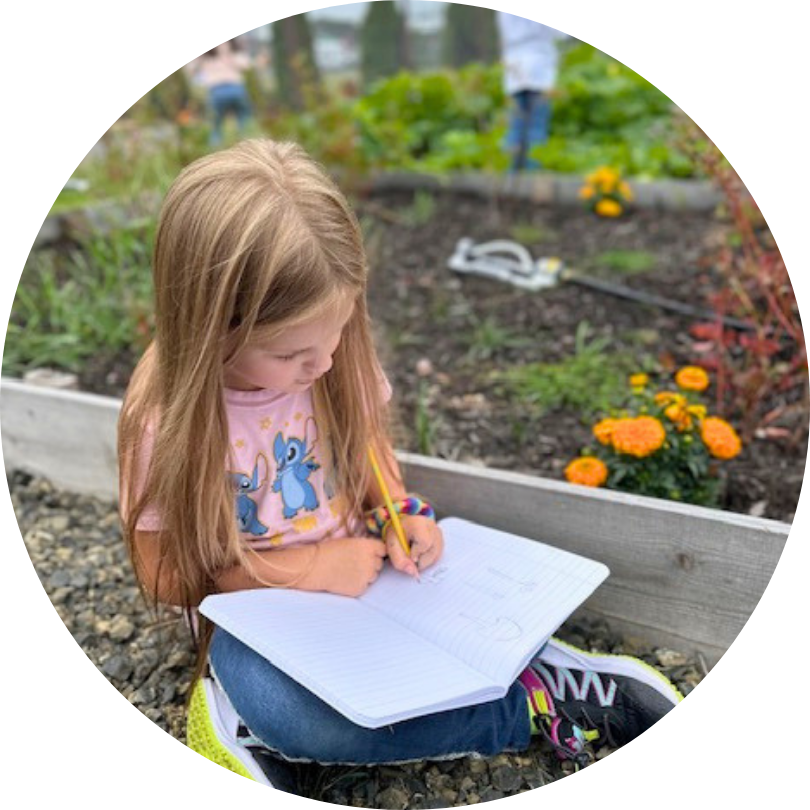
Garden journaling is an activity focused on spending time in the garden with the specific purpose of recording observations, feelings, thoughts, and pictures, either orally or in written form. Garden journaling is a great way for children to unplug, get some fresh air, and connect with nature and their feelings.
Garden journaling should be adapted to each child’s development level and skills. Depending on the child, garden journals may be a collection of drawings, a recording of simple words, or in paragraph form for more advanced youth. Journals can also be transcriptions of oral observations, written with the help of adults or youth assistants.
Below is a list of developmental skills that garden journaling can address. In the instructions, you’ll find ideas for modifying the activity to make it accessible to learners who may have specific physical, cognitive, sensory, and social/emotional needs. This resource is designed to help ensure all children in your program can engage with and have fun in the garden.
What Skills Does This Activity Support?
Physical – Fine motor skills, in-hand manipulation, gross motor skills, visual perceptual skills, hand eye coordination
Cognitive – attention, compare and contrast, memory
Sensory – sensory processing, tactile, visual, auditory, proprioceptive, and vestibular senses
Social/Emotional – creativity, patience, perseverance, socialization
Materials
- Notebook or pieces of paper with a clipboard
- Pencils, pens, markers, crayons, and/or colored pencils
- Phone or voice recorder
- Garden space
- Table
Planning Ahead
- Decide how you’ll convey the instructions. This will depend on the children’s ages and abilities. You can print them out and distribute them as a step-by-step reference guide for children to read and follow. You can attach them to each journal page for easy reference and a reminder. Alternatively, you can read each prompt to children at the appropriate time.
- Prepare to offer guidelines. These might include not touching insects or other creatures, moving rocks or other items, not venturing beyond a defined area, etc.
- Plan for adult supervision. If needed, recruit adults who can provide direct supervision to all children when they are walking around and observing a larger garden or outdoor area.
- Get inspired, so you can inspire your young journalers! Check out these articles: Garden-Inspired Writing, Nurturing Creativity in Kids, Writing Prompts for Storytelling in the Garden
Activity Instructions for Journalers
- Gather materials for garden journaling and head outside to the garden space.
- Take 3 to 5 minutes to simply observe the garden. You can sit in one spot or move around. If your teachers say it is okay, you can pick up objects like stones, or bend down or reach up to get closer to plants to take a closer look and smell. Think about engaging your senses! What smells, sounds, colors, and textures do you notice in the garden? Try to notice any feelings you have during this observation time.
- Once you’re done observing, find a comfortable place to sit or lie on your belly and journal.
- Decide what you want to journal about today. Did a plant catch your eye, and you want to describe the color and smell of it? Did you see a new type of animal in the garden and want to write all about it? You can even journal about your experience observing nature, including what you saw and felt.
- Start by drawing a picture of what caught your eye during observation time. Whatever you draw is a work of art! Try to incorporate different colors, and don’t be afraid to take up as much space in your journal as you need to draw your picture.
- Describe your picture by writing about it in your journal or talking about it to your teacher. What interesting things do you notice about this plant, animal, rock, etc.? You or your teacher can write down your thoughts on the same page as your picture using arrows to connect the words with your drawings, or you can write a few sentences about your picture on another page.
- If you don’t want to draw a picture, you can simply write down or tell your teacher what you observed in nature. What did your 5 senses pick up on? What feelings did you have in the garden? Did being in the garden make you happy, curious, excited, or calm?
- Journal for as long as it feels right for you. If you can, try to spend at least 5 minutes reflecting and writing in your journal.
- If it feels right, share what you wrote about in your journal with others and listen to your friends’ journal entries. Be sure to say kind things.
How to Modify this Activity for Different Learners’ Needs
Physical/Motor
- If fine motor skills like writing and drawing are difficult, children can collect garden materials and tape or glue them into their nature journal. Since we don’t want to encourage children to pick growing plant material, encourage them to find loose objects on the ground, such as fallen leaves, flower petals, seeds, small pebbles, or twigs.
- If children have difficulty grasping writing utensils, make them larger and easier to use by wrapping them in sticky medical tape or rubber bands.
- If navigating or exploring the garden space is hard, bring garden materials to the children! Adults can pre-gather and lay out garden materials for them to interact with, such as leaves, flowers, rocks, twigs, etc.
- Bring chairs, pillows, towels, and blankets outside for children to comfortably sit or lie on while journaling.
Cognitive
- Make this task simpler and more manageable for children by providing them with specific instructions when observing and exploring the garden space. For example, invite them to find a flower to journal about, rather than having them explore the garden and then decide on a topic to write about.
- Another way to make this task easier is to provide children with a garden journal prompt, rather than asking them to decide what they want to write about. Be sure to make your prompts fun and playful. See here for some fun garden-based storytelling writing prompts.
- Although you don’t want to rush children through this activity, providing gentle structure can be helpful to accomplish the task for those with attention challenges. Talk with children about a plan to observe the garden for around 3-5 minutes, then journal for another 5 minutes. Provide gentle cueing when they have 3 minutes left to observe nature. You can always increase the time if your children seem to want and need it. You may want to play soft music when it’s time for them to start journaling, and then turn it off when they find a spot to sit and start journaling.
Sensory
- Garden journaling provides a great opportunity for multisensory enrichment. While children are walking around observing the garden, encourage them to bend low down to the ground to observe plants or stand on their tip toes to get a closer look at the taller plants, to gently touch them, look at them and even listen to hear if they are ‘saying’ something.
- If children are having trouble getting their journal entry started, invite them to find a plant and describe it to you. These observations about color, shape, texture, are great ways to engage the visual and tactile sensory systems and jumpstart ideas for their journal entry.
- Have children lie on their bellies (on a blanket or towel if they choose) while writing in their journal outside. This is a great way to provide calming proprioceptive and vestibular sensory input.
- Adding weight to a pen or pencil can help provide proprioceptive sensory input, making it easier for some children to write with. Some DIY ideas to add weight to a writing utensil include taping/gluing small items like pennies or washers to the top of it, then covering it with medical tape.
Social/Emotional
- Encourage children to practice identifying emotions by inviting them to add one feeling word to their garden journal. For example, they could start off their journal entry with “Today I am feeling …”
- If children are comfortable with sharing their garden journal, ensure the space is welcoming, as sharing journal entries can feel vulnerable. Invite children to listen closely while friends are sharing, and encourage them to offer words of encouragement to their friends after they share.
- Remind children that everyone’s garden journal will be different, and there are no right or wrong ways to complete a garden journal. The first time, it may feel like learning a new skill, like riding a bike. Whatever they feel comfortable writing, drawing, or sharing is okay, and giving it their best try is what counts.
Explore the full resource guide: https://kidsgardening.org/resources/everyone-grows/
Related Resources
- Everyone Grows: Planting Seedlings
- Everyone Grows: Planting Container Gardens
- Everyone Grows: Indoor Seed Planting
Subscribe
Our FREE monthly newsletters help kids play, learn, and grow through gardening. Get the best gardening ideas for kids right in your inbox!

Excited to garden with kids?
Explore more resources, discover funding opportunities, ask questions, and learn with other gardeners in the Kids Garden Community. Join FREE today to start connecting, sharing, and growing with educators and parents just like you!