
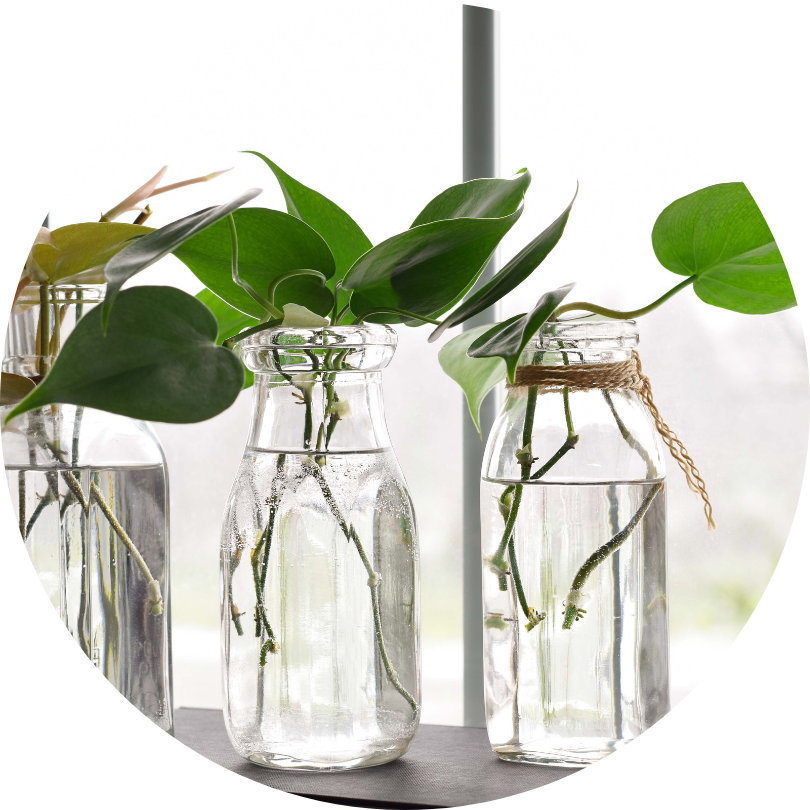
Plants have the unique ability to regenerate whole new plants from their parts, such as from a piece of root, stem, or leaf. Practicing plant propagation by making new plants from existing plants can feel like magic to young gardeners, and it also teaches them a lot about plant growth and development. In this activity, they’ll take cuttings (pieces of stem), place them in water and a soil mix, and observe them over several weeks to watch for root development.
Below is a list of developmental skills this plant propagation activity can address. In the instructions, you’ll find ideas for modifying the activity to make it accessible to learners who may have specific physical, cognitive, sensory, and social/emotional needs. This resource is designed to help ensure all children in your program can engage with and have fun in the garden.
What Skills Does This Activity Support?
Physical – Gross motor strength, co-contraction, range of motion, grip strength, pinch strength, and hand-eye coordination
Cognitive – attention, sequencing, compare and contrast, concentration, safety, judgement, memory, and problem solving
Sensory – sensory processing
Social/Emotional – communication
Materials
- Plastic water or soda bottles (16 oz. or ½ liter sizes are best), two for each child
- Watering can, pitcher, or other vessel for holding water
- Water
- Large bowl or bucket (for moistening soil mix)
- Soilless potting or seed-starting mix
- Trowel, ice cream scoop, large spoon, or other tool for scooping soil
- Ruler
- Scissors
- Plants (for cuttings): Commonly available plants that readily root in water and soil include basil, coleus, peperomia, polka dot plant, and silver inch plant (Tradescantia zebrina). You’ll need enough plant material to let each child make two 4” to 6” cuttings.
Optional materials for activity modifications: Tape, child-sized disposable gloves, small funnel, or parchment paper that can be rolled into a funnel shape.
Planning Ahead
- Prepare the plastic bottles: Remove the caps and use sturdy scissors to cut off the narrow tops of the bottles. Take care to trim off any sharp edges so the cut is relatively smooth. Note: Cutting plastic can be tricky and should be done by an adult in advance.
- Moisten the soilless potting mix. Pour it into a large bowl or bucket, add warm water, and stir. Peat-based soilless mixes tend to repel water; you may need to add some water, stir, and let the material sit, repeating until the mix is evenly moist (like a damp sponge) but not soaking wet.
Activity Instructions
- Using the watering can, pitcher, or other vessel, fill one water bottle halfway full with water. This will be the vase.
- Fill the second water bottle with moistened soil using a trowel, scoop, or spoon, so it is about halfway full. This will be the pot.
- Demonstrate for children how to take plant cuttings: Using clean scissors, cut a section of stem that measures 4 to 6 inches long and has at least 4 leaves. Remove the lower leaves from the cutting so that the bottom 2 to 3 inches of stem are bare.
- Have each child take 2 plant cuttings from the same plant. Have them use their fingers or scissors to remove the bottom leaves.
- Place one cutting in the vase (the bottle with water). The leafless part of the stem should be submerged, and the part of the stem with the leaves should be exposed. You may need to pour out some water during this step so that the water is at the correct level.
- Place the other cutting in the pot (the water bottle with soil). Arrange the cutting so the stem is against the side of the pot, so the roots will be visible as they grow. The plant’s leaves should be above the soil surface.
- Monitor plants and record any changes. Compare and contrast any differences between the plant in the pot and the one in the vase.
- Continue to add water to the vase if it falls below the original level. Add water as needed to ensure the soilless mix in the pots stays moist but not saturated.
- Once the plants grow roots, transfer them to large pots.
How to Modify this Activity for Different Learners’ Needs
Physical/Motor
- If children would benefit from a stabilizer to hold the plant steady for taking cuttings, tape the plant to a desk or wall. This allows them to use both hands for cutting, balance, and/or support as needed.
- Children can fill their water bottle “vase” from the sink rather than pouring from a container/watering can.
- Put a plastic funnel in the water bottles to help children pour the water into the bottles more easily. You can make a homemade funnel for adding the soil by rolling up a piece of parchment paper into a cone shape.
Cognitive
- While providing instructions on how to cut plants for propagation, use verbal, written, and visual demonstrations to accommodate all children.
- Provide an example picture of what a finished plant cutting should look like.
- Break this task up into separate days. Day 1 could be preparing and filling the vases; Day 2 could be preparing the pots; and Day 3 could be the propagation cutting day. Breaking up the task may help children stay engaged throughout each step.
- Help children determine where to cut the plant stem with visual hints. You can tie a ribbon or put a clothespin around the stem, or simply place your finger on the spot on the stem where children are meant to cut.
Sensory
- Take this activity outside! It eliminates the stress of cleaning up a mess inside and allows children to enjoy fresh air and sunshine.
- Encourage children to engage multiple sensory systems by making observations about the soil and water. Have them identify what differences they feel, see, and smell between the soil and the water. Ask them how they think these differences will impact the growing plant!
- Provide gloves for children to use during this activity, even if it’s thin rubber ones to keep their hands clean and dry.
- Facilitate opportunities for children to engage in heavy work throughout this activity. Tasks like carrying a filled watering can or scooping soil can provide proprioceptive input and help children who tend towards sensory craving to feel calm and regulated while participating in the activity.
Social/Emotional
- Try this activity with partners! Children may benefit from having a buddy to help them cut the plants, fill the containers, and place the plants in them.
- Have children monitor plants and discuss with a buddy. This can be a great way to support socialization among peers.
- Try different ways to encourage young gardeners to report progress. They can talk about it with a buddy, color a picture of a plant showing how much it’s growing, or point to a picture to identify what stage the plant is at when given different pictures of the plant; seeds, budding, stem, leaves, flower/fruit.
- If children try to take cuttings and plant all at the same time, the learning environment could get pretty busy! Try splitting children into groups and assigning them to workstations with an adult at each station for support. This can help keep the environment calm, quiet, and organized.
Related Resources
- Everyone Grows: Introduction
- Everyone Grows: Planting Seedlings
- Everyone Grows: Indoor Seed Planting
Subscribe
Our FREE monthly newsletters help kids play, learn, and grow through gardening. Get the best gardening ideas for kids right in your inbox!

Excited to garden with kids?
Explore more resources, discover funding opportunities, ask questions, and learn with other gardeners in the Kids Garden Community. Join FREE today to start connecting, sharing, and growing with educators and parents just like you!