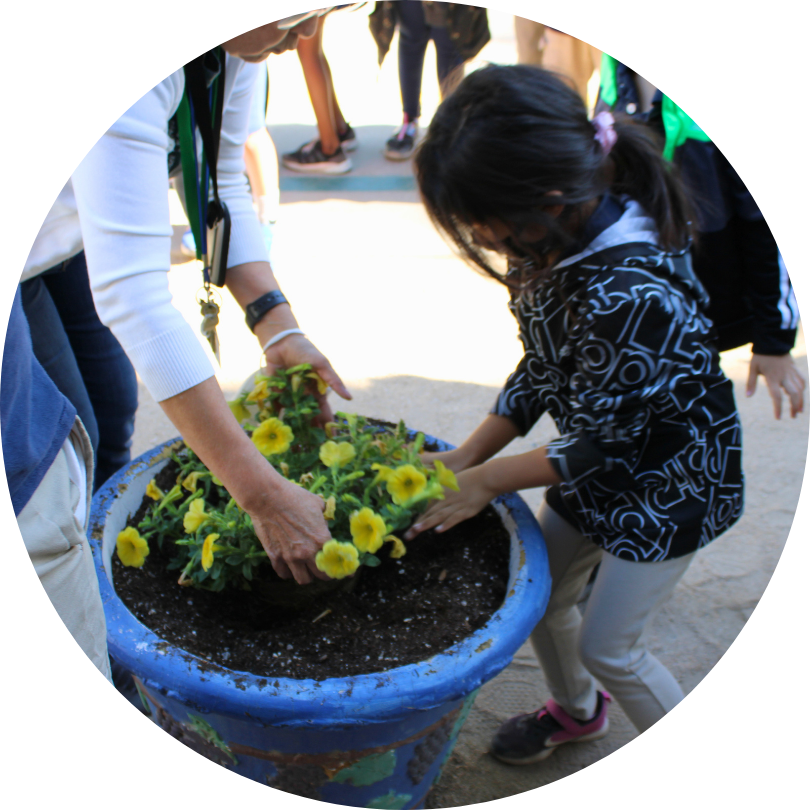
Planting container gardens is a great way to add plants to challenging spaces and to start your gardening adventures on a smaller scale. Container gardens offer a lot of flexibility, too, so you can adapt your garden program to meet the diverse needs of your young gardeners. In this activity, children will decorate a container and then plant seeds or seedlings.
Below is a list of developmental skills that planting container gardens can address. In the instructions, you’ll find ideas for modifying the activity to make it accessible to learners who may have specific physical, cognitive, sensory, and social/emotional needs. This resource is designed to help ensure all children in your program can engage with and have fun in the garden.
What Skills Does This Activity Support?
Physical – Motor planning, fine motor skills, grip strength, range of motion, gross strength, and hand eye coordination
Cognitive – problem solving, attention, and planning
Sensory – sensory processing, and tactile and visual skills
Social/Emotional – patience, perseverance, and creativity
Materials
- Containers: These can be purchased pots or repurposed items, such as buckets, colanders, wooden crates, or even old boots or hanging shoe organizers!
- Potting mix, ideally a well-draining soil mix labeled for container gardening. Don’t use garden soil as it is too heavy, holds too much moisture, and may harbor plant disease organisms.
- Wheelbarrow or large bucket for moistening potting mix
- Awl or drill, if needed, to create drainage holes in repurposed containers
- Decoration materials: Paint or waterproof glue and small items such as shells, smooth pebbles, and beads
- Waterproof glue
- Water
- Trowel
- Spray bottle
- Watering can
- Drip tray
- Seeds and/or seedlings/transplants
Optional materials for activity modifications: Child-sized disposable gloves.
Planning Ahead
- Decide what you want to grow and purchase seeds and/or plants. A wide range of plants grow well in containers, including vegetables, herbs, and flowering plants. Some plants, such as tomatoes and peppers, grow best from seedlings, while others can be started from seed, such as zucchini and sunflowers. It’s usually best to grow one plant, or one type of plant, in each container. If you want to grow several plant types in one container, make sure they have similar sunlight and water needs. It is important to let your young gardeners have a say in what they want to grow.
- Select the containers. You can purchase containers or use repurposed items. If growing edible crops in buckets, be sure to use food-grade buckets. Match the size of the container to the plant. For example, small containers that hold around 3 gallons are good for compact plants like lettuce and herbs. Larger plants, such as tomatoes and squash, do best in larger containers, such as 5-gallon buckets or pots.
- Add drainage holes, if needed. Drill or poke five to seven ¼”- to ½”-diameter, evenly spaced holes across the bottom of buckets and other repurposed containers.
- Plan for care. Newly planted containers need frequent care, including regular watering, to ensure the plants get established. In general, plants growing in containers need more frequent watering and fertilizing than plants in garden beds. The smaller the container, the more frequently it will need watering.
Activity Instructions
- Decorate the outside of the container before you begin planting. This is an optional — but fun! — part of the activity. If doing this step with waterproof glue, gloves are a must to prevent the glue from contacting the learner’s skin. Allow paint or glue to dry before planting.
- If the potting mix is dry to the touch, moisten it before using. Pour the mix into a wheelbarrow or large bucket, add water, and stir until the mix is evenly moist but not soaking wet. Note that peat-based potting mixes tend to repel water; you may need to add water, stir, and let the mix sit, repeating until it is evenly moist.
- Scoop the moist soil into the container with a trowel or gloved hand. If you’re planting seeds, add soil to within about an inch from the top of the container. If you’re planting seedlings, add less soil.
- Plant your seeds following directions on the seed packet.
- If planting seedlings, use a trowel or your hands to create a planting hole. Set the plants in the hole and backfill with potting mix, firming it as you go. Adjust the height of the plant as needed so that the top of the root ball is at the soil surface. You want the soil mix to end up about an inch below the rim of the pot. Learn more about it in the Planting Seedlings activity.
- Use a watering can to gently moisten the soil, taking care not to dislodge seeds or seedlings.
- Place the container outdoors in a spot that meets your plants’ sunlight needs.
- Check the soil every few days and water as needed to keep the soil evenly moist. To ensure all the soil is moist, apply water until it drains from the bottom of the container. If the soil has dried and pulled away from the edges of the pot, set the container in a basin of lukewarm water for an hour to allow the soil to rehydrate. Then remove it and allow excess water to drain.
- Fertilize plants weekly using an all-purpose organic fertilizer.
How to Modify this Activity for Different Learners’ Needs
Physical/Motor
- Choose containers for planting that can help young gardeners be successful. For example, some children may benefit from using shorter containers that are easy to fill with soil and reach into for planting, and some may benefit from ones with handles to make carrying and holding the container easier. Some children may benefit from heavy containers that will stay in position, and others may benefit from light containers that can be moved. Some children may benefit from using a brightly colored container that is easy to see!
- Provide crafting supplies that all children can have fun with and be successful with. Examples include dot paint pens, thick paint brush handles, foam paint rollers, and paint stamps! Other options, if gluing is desired, are shells, large beads, and smooth pebbles.
- If holding a trowel to scoop soil is difficult, try another type of tool. A mug with a handle works great to scoop soil and may be easier to hold.
Cognitive
- Have children watch you draw a line on the container or bucket with a permanent marker to indicate the soil fill line.
- Support children by providing them with helpful cues or short instructions from the seed packet directions. The most important information for this activity is seed depth and seed spacing. If seeds should be 2 inches apart, give examples of familiar items that are 2 inches, such as a pinky finger.
- Break this task up into separate days. Day 1 could be preparing and filling the vases; Day 2 could be preparing the pots; and Day 3 could be the propagation cutting day. Breaking up the task may help children stay engaged throughout each step.
- Your directions should be short, simple, and straightforward to be most effective. Eliminate extra words to help children absorb the most helpful information needed to complete the task. Instead of saying, “Now, you need to plant all 5 of the seeds so that they are spaced out about 1 inch apart from each other in the soil inside the bucket,” say, “Place the seeds 1 inch apart.”
Sensory
- Take this activity outside! It eliminates the stress of cleaning up a mess inside and allows children to enjoy fresh air and sunshine.
- Checking if the soil is moist uses different sensory systems. Children can touch the soil, look at it, or have a friend push down the soil, and they can listen for the “squish” of moist soil!
- Tools like a drill can be quite noisy and difficult for some children to tolerate. Try to drill the holes on the bottom of the containers before the activity starts.
- Adding weight to a trowel can help provide proprioceptive sensory input, making it easier to scoop with. Some DIY ideas to add weight to a trowel include taping/gluing small items like pennies or washers to the handle of the tool then covering it with medical tape.
Social/Emotional
- Give children a few choices of what they would like to plant. Provide them with pictures of the different seeds they can choose from and what they will look like when grown. This can help support children’ s independent decision-making skills.
- Support socialization by encouraging, but not requiring, children to share their decorated containers with the group or peers.
- Make sure to build in breaks and check-ins during this activity if done in a group setting to avoid children falling behind or feeling rushed.
Related Resources
- Everyone Grows: Planting Seedlings
- Everyone Grows: Indoor Seed Planting
- Everyone Grows: Plant Propagation
Subscribe
Our FREE monthly newsletters help kids play, learn, and grow through gardening. Get the best gardening ideas for kids right in your inbox!

Excited to garden with kids?
Explore more resources, discover funding opportunities, ask questions, and learn with other gardeners in the Kids Garden Community. Join FREE today to start connecting, sharing, and growing with educators and parents just like you!