
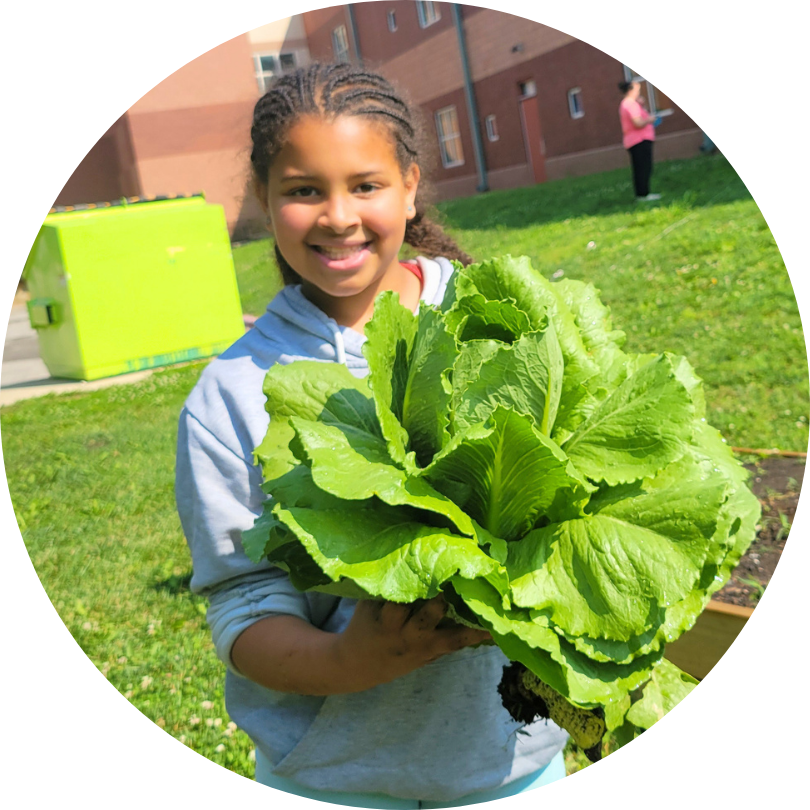
Harvest is an exciting time for children as they get to pick and enjoy the produce they worked hard to grow in the garden. Children who help grow and harvest produce may even be more excited to eat it compared to what comes from the store. In this activity, children will learn how to harvest and wash food from their garden.
Below you will find a list of developmental skills harvesting can address. In the instructions you’ll find ideas for modifying the activity to make it accessible to learners who may have specific physical, cognitive, sensory, and social/emotional needs. This resource is designed to help ensure all children in your program can engage with and have fun in the garden.
What Skills Does This Activity Support?
Physical – Range of motion, coordination, fine motor skills, digit opposition, bilateral coordination, grip strength, hand eye coordination
Cognitive – inhibition, attention
Sensory – sensory integration, proprioception, vestibular and tactile skills, interoception
Social/Emotional – patience, perseverance
Materials
- Harvest-ready produce
- Sink with running water
- Food-grade soap
- Food-grade containers or food-grade plastic bags
- Scissors
- Paper towels and cloth kitchen towels
- Scrub brush
- Clean gloves
Planning Ahead
- Determine what’s ready to harvest. Survey garden plants before the activity and decide which crops you’ll be harvesting. Research the best way to pick them, as different fruits and vegetables require different harvesting methods. This may include plucking from the branch with your fingers or cutting off a stem using a knife or scissors (the latter should be done by adults or with close supervision).
- Research storage techniques. Some crops should be washed right after harvest and before storage; others should be stored as is and washed just prior to use. Research the best storage temperature — some crops should be refrigerated, and some stored at room temperature.
Activity Instructions
- Adults: Ensure all children participating in harvesting produce are feeling well and have no open cuts or sores on their hands or arms. Thoroughly wash hands with soap and clean water, and dry hands with a towel. If handwashing is not an option, children can wear clean gloves.
- Lay out paper towels on a counter or table.
- With adult supervision: If using a reusable food-grade container to harvest, wash it beforehand using warm, soapy water and let it dry. Also, wash and dry any harvesting tools beforehand.
- Share with children what produce they are going to harvest and explain the best way to pick it. We recommend that adults complete harvesting that requires a knife or scissors, or provide direct supervision to children using these tools.
- Harvest your produce by removing it from the plant’s stem or branch. For fruit, such as berries, use your fingers to remove them from the tree, vine, or bush. Gently grasp the berry with your fingertips while steadying the branch it is attached to with your other hand. Lightly twist the berry with your fingertips to carefully remove it from the branch. Place the harvested produce in a washed container or clean bag.
- Carry the container or bag inside. Take out the harvested produce and set it on the paper towel-covered table. Gently rub off any excess soil or debris using paper towels.
- Explain to children that all crops will be washed. Some will be washed now, and others will be stored as is and then washed just prior to use.
- To store crops as is, place the produce in a new, clean plastic bag or a clean, dry container. Place the produce on the counter or in the refrigerator, depending on the crop’s optimal storage temperature.
- When it’s time to wash your harvest, use clean, running water that is no more than 10 degrees cooler or warmer than the temperature of your produce. Rinse the produce in the sink for around 60 seconds, or soak it in a large bowl with enough water to cover it for 1 to 5 minutes, until all the soil and debris have sloughed off. Use a scrub brush to remove any remaining soil and hard skin from produce such as potatoes or carrots.
- To help prevent mold and bacterial growth, thoroughly dry the produce with a clean kitchen towel. Store the precious produce at the appropriate temperature.
- Eat now or when you are ready. Enjoy!
How to Modify this Activity for Different Learners’ Needs
Physical/Motor
- If fine motor skills like pinching to harvest produce is difficult, provide hand-over-hand assistance to children by gently placing your hand around theirs and lightly guiding their hand to help pinch and remove produce.
- If the produce bucket/bag is too heavy to carry while harvesting, adults can carry a common bucket for children to place their harvested produce in.
- Children can use a strainer to hold the produce under running water, rather than holding and washing or scrubbing each fruit/vegetable individually. Adults should decide whether the produce still needs further scrubbing to be clean.
- If skills like gripping and pinching are difficult, help children scrub produce by holding the vegetables for them so they can focus on scrubbing. Make the handles of vegetable scrubbers larger and easier to grasp by wrapping them in sticky medical tape, or purchase a vegetable scrubber that slips over the finger and may be easier for some children to use.
Cognitive
- Talk about and give a physical demonstration of how to harvest produce properly. Include tips like avoiding pulling on branches or squeezing fruit too hard when removing it from the branch.
- Help children stay engaged and attentive during this task by timing it right. If children are tired or antsy by the end of the day, aim to harvest at the beginning of the day when it might be cooler.
- Another way to help increase engagement with harvesting is to make it into an “I spy” game! Cue children: “I spy a red fruit that is small and round” to help them spot and harvest a ripe tomato.
Sensory
- Provide gloves for children who want to avoid getting messy from produce juice, sticky residue, or soil.
- Encourage children to be aware of their senses during this activity! What do you smell while harvesting? What color is the produce? What does the produce feel like? Is it soft, firm, fuzzy, or smooth?
- Invite children to eat the produce (after washing) to engage their sense of taste. Ask them what it tastes like! Is it sour or sweet? Crunchy or soft?
- While harvesting, encourage children to reach up and down and side to side with their arms and hands, which provides vestibular sensory input. Another way to increase vestibular and proprioceptive input is by inviting children to stand on one foot while harvesting produce!
- Respect children’s preferences for touching and interacting with produce or to eat it or not. Children who trend towards sensory avoiding behaviors may not be as comfortable with touching or smelling different fruits or vegetables.
Social/Emotional
- Some children may benefit from having a structured timeline for this activity. Let students know in advance that you will be harvesting for 30 minutes (or however long you choose). Cue them when they are halfway through and when you have 5 minutes left. You can use your voice or a pleasant timer sound. This strategy may help children avoid feeling the need to rush through the activity. Time cueing also provides a predictable structure for an activity that doesn’t have a specific endpoint.
- Let children engage with harvesting at their own pace and comfort level and provide opportunities to participate in the activity without directly interacting with produce, like holding and carrying the bucket or just watching.
- At the end of the activity, invite children to reflect and share about their harvesting experience. Encourage them to consider what they learned about teamwork during this activity, one thing that thought went well, or something new they learned.
1Holloway, Timothy P., et al. (2023). School gardening and health and well-being of school-aged children: A realist synthesis. Nutrients 15(5), 1190, https://doi.org/10.3390/nu15051190.
Explore the full resource guide: https://kidsgardening.org/resources/everyone-grows/
Related Resources
- Everyone Grows: Planting Seedlings
- Everyone Grows: Planting Container Gardens
- Everyone Grows: Indoor Seed Planting
Subscribe
Our FREE monthly newsletters help kids play, learn, and grow through gardening. Get the best gardening ideas for kids right in your inbox!

Excited to garden with kids?
Explore more resources, discover funding opportunities, ask questions, and learn with other gardeners in the Kids Garden Community. Join FREE today to start connecting, sharing, and growing with educators and parents just like you!