
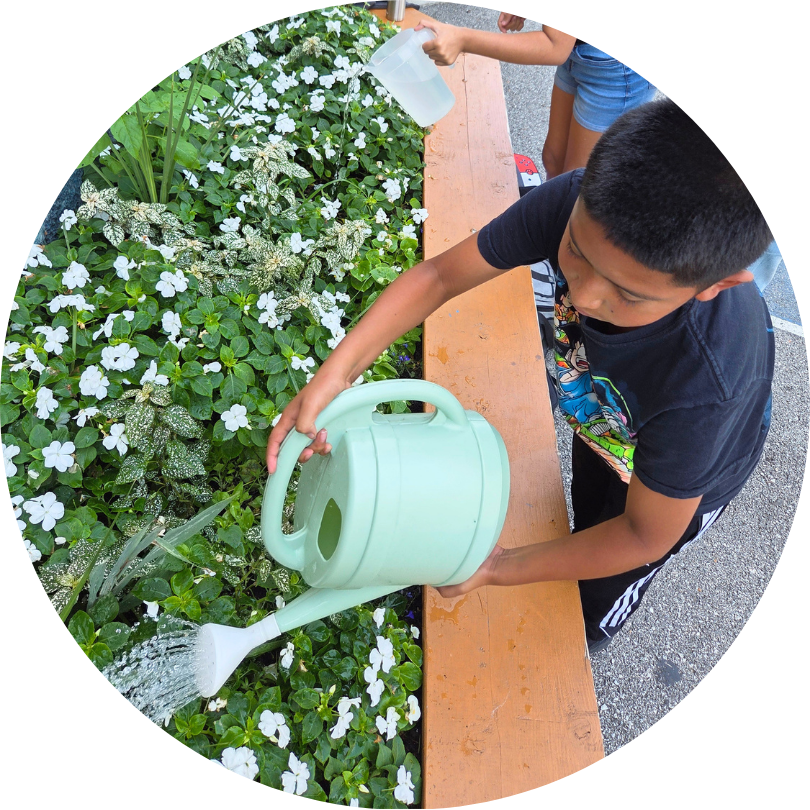
Water is essential for a healthy garden. That said, both too much and too little water can significantly impact plant growth. Teaching young gardeners to recognize when plants need water and to use proper watering techniques is one key to a flourishing garden. Watering by hand is the most basic method for providing supplemental water when rainwater doesn’t suffice. In this activity, children will learn to tell when plants need water and how to water them by hand.
Below you will find a list of developmental skills that hand watering can address. In the instructions, you’ll find ideas for modifying the activity to make it accessible to learners who may have specific physical, cognitive, sensory, and social/emotional needs. This resource is designed to help ensure all children in your program can engage with and have fun in the garden.
What Skills Does This Activity Support?
Physical – Gross motor skills, gross strength, grip strength, motor planning, coordination, bilateral skills, co-contraction, range of motion, strength, balance, hand eye coordination, visual perceptual skills
Cognitive – inhibition, attention
Sensory – sensory processing, tactile, proprioception, and vestibular senses
Social/Emotional – patience, perseverance
Materials
- Outdoor water source (generally a spigot/hose bib)
- Watering can with sprinkler head or hose with adjustable nozzle
Optional materials for activity modifications: Single-use plastic water bottle (to make DIY squeezable watering can)
Planning Ahead
- Gather equipment. If you’ll be using watering cans, keep in mind that water weighs about 8 pounds per gallon. Be sure to choose a watering can that is sized for your young gardeners. Ideally, the watering can will have a sprinkler head (also called a rose) that applies a gentle shower. If using hoses, select adjustable spray nozzles that allow you to start and stop the flow and that offer a range of volume and pressure options. Note the location of the outside water source nearest the garden. If there is no outside source, determine how you will transport water from an indoor source.
- Learn how to identify when gardens need watering. The easiest way is to test the soil for moisture by inserting a finger about an inch into the soil to see if it feels moist or dry. Another method is to insert a long screwdriver into the soil; it will pass easily through moist soil, but will be difficult to push into dry soil. For vegetable gardens, it’s time to water when the top inch or so of soil is dry. Keep in mind that it’s best to water plants before they show signs of water stress, such as wilting leaves and bending stems; if you see these signs, water immediately! Remember that applying too much water or watering too frequently can lead to root rot.
- Time the activity. Choose a time when rainfall has been inadequate for plants. You want to apply water only when plants need it, rather than on a set schedule. This prevents overwatering and conserves this precious resource.
Activity Instructions
- Help children identify the areas in your garden that need watering.
- If you are using a watering can, carry it to the water source. Hold the watering can beneath the spigot. If there is a hose attached to the spigot, aim the nozzle of the hose into the opening of the watering can. Turn the faucet on and fill the watering can with the appropriate amount of water. Note: The more water you add to the can, the heavier it will be for a child to carry.
- Carry the watering can to the garden. For better balance, if it feels heavy, grasp the watering can by the handle with one hand and place the other hand under the can to support it.
- Hold the watering can about 6” above the soil around the plant you want to water. Aim the spout toward the soil at the base of the plant, then slowly tilt the watering can downwards. This ensures that the water is applied directly to the soil where plants need it. It also helps keep foliage dry, minimizing disease problems. Hold the watering can steady and continue tipping it downward until water begins flowing onto the soil.
- Water the plant for the appropriate amount of time. This may vary by plant and soil type! Smaller plants in heavy soils may only need about 10 seconds of watering, while larger plants may need closer to 15-20 seconds or longer. You can insert a finger or a screwdriver to determine if water has moistened the top few inches of soil. Stop watering the plant by returning the watering can to an upright, level position.
- Continue this process for all plants that need watering. If you are watering many plants, you may need to refill the watering can multiple times.
- If watering with a garden hose, grasp the nozzle (or the end of the hose) before turning it on. Be sure to set the nozzle to a gentle stream or shower setting so the plant does not get damaged by the water’s force. While holding the nozzle steady and pointed away from you, grasp the faucet handle and turn it to the left. Test whether the water is flowing through the hose by squeezing the nozzle handle and watching for water to come out. Let go of the nozzle handle to stop the water flow.
- Bring the hose to the garden. Aim the nozzle at the soil as the base of the plant you are going to water.
- Squeeze the nozzle handle to produce a gentle stream of water that flows over the soil around the base of the plant. Continue squeezing the nozzle handle to water the plant for the appropriate amount of time, then release the handle to stop the flow.
- Continue this process until you have watered all the plants.
How to Modify this Activity for Different Learners’ Needs
Physical/Motor
- Fill the watering can halfway if it is too heavy for children to carry around the garden.
- Try using different types of watering cans or DIY options. If a standard watering can is too heavy or difficult to hold, you can use a small cup to water your plants. You can also make your own DIY watering cans from plastic water bottles, or purchase a lightweight option that’s easy to squeeze with one hand.
- If the hose nozzle is difficult to squeeze, take it off and invite children to water plants with a slow flow of running water from the hose, being mindful of over-watering.
- Talk with children about proper body mechanics to prevent injury when watering. Model how to bend at the hips and knees when holding something heavy, like a watering can, rather than bending over with knees straight, which can strain the back.
Cognitive
- Discuss with children the potential problems of overwatering plants and count out loud with them the amount of time they need to water each plant.
- Support success by adding structure to the activity. Pick one row to start watering in and work your way forward/back or across the rows. This is a good way to help children stay organized and focused on the activity, and ensures each plant gets watered, and children are pleased with their efforts to complete the task.
- Encourage children to practice problem solving and their compare-and-contrast skills. For example, ask children to compare different sized plants and decide which one they think needs more water.
Sensory
- This activity can get muddy! Offer children the option to wear rain boots or old shoes to prevent their socks and shoes from getting wet and muddy.
- Provide gardening gloves for children who want to avoid getting their hands dirty or wet while using the hose or watering can.
- For children who trend towards sensory craving, doing “heavy work” like carrying the filled watering can provides calming proprioceptive sensory input.
- Have potable drinking (not hose!) water and a shady spot to rest readily available for children if you are hand watering on a hot day!
Social/Emotional
- Hand watering is a great way to practice taking turns and promotes teamwork amongst children. If you only have one watering can or hose, encourage children to take turns using it. You can also encourage teamwork by having two children carry the hose or watering can if it is heavy.
- Establish expectations and boundaries before starting the activity so that all children feel safe. Make sure you explain to children that the hose water is just for the plants today and not to spray other friends.
- Encourage children to suggest their own expectations for the activity, encouraging boundary setting and decision making.
- After the plants are watered, encourage children to say one thing they did well during the activity and one thing they saw a friend do well. Examples could be children demonstrating sharing, turn-taking, being patient, encouraging others, etc.
Related Resources
- Everyone Grows: Planting Seedlings
- Everyone Grows: Planting Container Gardens
- Everyone Grows: Planting Seeds Outside
Subscribe
Our FREE monthly newsletters help kids play, learn, and grow through gardening. Get the best gardening ideas for kids right in your inbox!

Excited to garden with kids?
Explore more resources, discover funding opportunities, ask questions, and learn with other gardeners in the Kids Garden Community. Join FREE today to start connecting, sharing, and growing with educators and parents just like you!